
- Home
- Industrial hoses
- By application
- Hoses for liquids
- Hoses for air and aeration
- Hoses for gases and welding
- Hoses for hydrocarbons
- Abrasion resistant hoses
- Composite type hoses
- Hoses for chemical products
- Hoses for steam
- Firefighter and fire protection hoses
- Hoses for food products
- Hoses for fumigation
- Hoses for water
- Hoses for compressed air and pressure
- Marine hoses
- Garden hoses
- Hose guards
- By sector
- By materials
- By application
- Couplings
- Hydraulics and pneumatics
- More products
- About Us


 Rubber and silicone sheets
General-purpose black rubber sheet with fabric insertion
€0,00 VAT included (21%)


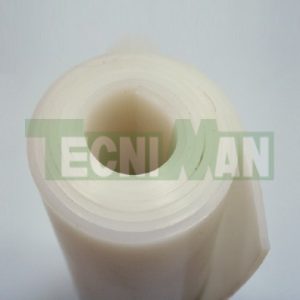


Rubber sheet and silicone sheet: types and uses
A rubber sheet is an elastomer sheet, supplied in rolls, that is cut to make gaskets, protective linings, loading guides or insulation. The material determines what it withstands: SBR for general gaskets, NBR against oils, EPDM for outdoor use, FKM (Viton) against acids, and silicone for food use up to +200 °C.
Types of rubber and silicone sheet
| Sheet | Material | Temperature | Hardness (SH) | Suitable for |
|---|---|---|---|---|
| General-purpose black rubber | SBR | -25 to +70 °C | 65 | General gaskets |
| Virgin natural rubber | Brown NR | -40 to +80 °C | 43 | Impact, tearing and rubbing; dilute acids and bases |
| Green abrasion-resistant rubber | Green NR | -40 to +80 °C | 50 | Loading guides and skirts on conveyor belts |
| EPDM | Black EPDM | -45 to +120 °C | 60 | Ageing, ozone and corrosive chemicals |
| Nitrile | Black NBR | -15 to +90 °C | 65 | Oils, hydrocarbons and solvents |
| White non-toxic nitrile | White NBR | -45 to +90 °C | 65 | Food industry, edible oils and fats |
| Neoprene | Black CR | -30 to +90 °C | 60 | Abrasion; does not spread flame |
| Viton fluoroelastomer | Black FKM | -35 to +140 °C | 70 | Temperature and highly concentrated acids |
| Silicone | Semi-transparent silicone | -50 to +200 °C | 60 | Food use (FDA) and electrical insulation |
| Red sponge rubber | Sponge EPDM | 60 °C | 30 | Thermal and acoustic insulation |
Thicknesses and formats
The sheets are supplied in rolls 1400 mm wide (1200 mm for silicone and 1000 mm for sponge rubber), with thicknesses from 1 to 35 mm depending on the material: up to 10 mm for silicone and Viton, up to 20 mm for EPDM, black nitrile and neoprene, up to 30 mm for general-purpose rubber and white nitrile, and up to 35 mm for natural and sponge rubber (the latter from 3 mm). Rolls are 3 to 20 m long. Polyurethane (80, 90 or 95 SH) is supplied as plates from 1 to 10 mm and as bars from 12 to 250 mm in diameter.
Frequently asked questions about rubber and silicone sheets
Which rubber sheet resists oils and hydrocarbons?
Nitrile (NBR), with good resistance to oils, hydrocarbons and solvents. Neoprene withstands them moderately, and general-purpose SBR rubber is not recommended for them.
Which silicone sheet is suitable for food?
Our silicone sheet is non-toxic, food grade and manufactured to the FDA standard, and works from -50 °C to +200 °C. A more economical alternative is the white non-toxic nitrile sheet, resistant to edible oils and fats.
Which sheet resists weathering and ozone?
EPDM, with excellent resistance to ageing and ozone. Nitrile, by contrast, is not recommended where there is ozone.
Which sheet is used on conveyor belts?
The green abrasion-resistant rubber sheet, made of natural rubber, in thicknesses of 8, 10 and 12 mm. It is cut to size to your specifications.
What is the sheet with fabric insertion for?
It is SBR rubber with one fabric insertion, for gaskets working at very high pressures. Sheets with several fabric insertions or with metal insertions are available on request.
See also rubber flooring, rubber bars and cords and our waterproofing section.